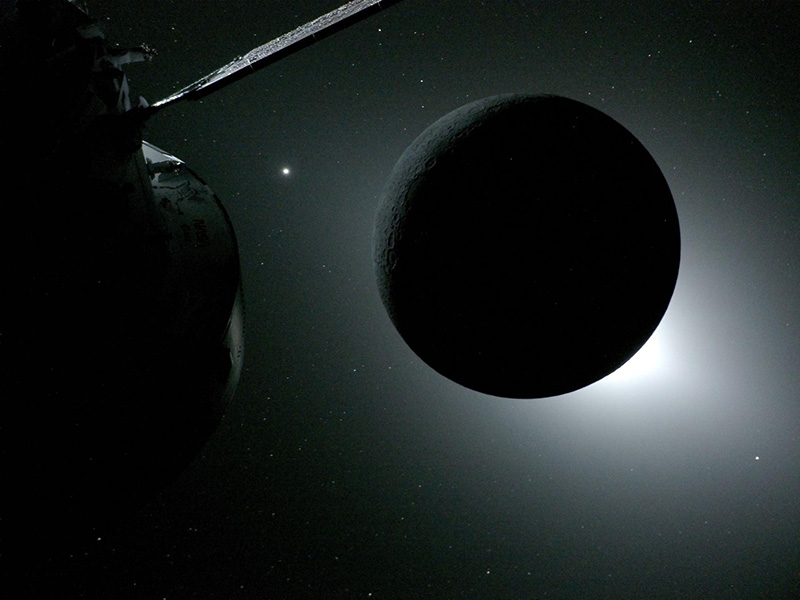
The Moon, backlit by the Sun during a solar eclipse, is photographed by NASA’s Orion spacecraft on April 6, 2026, during the Artemis II mission. [CREDIT: NASA]
By Stephen Borgna
Marketing Communications Specialist
It’s been more than 50 years since humans ventured beyond low Earth orbit. The last ones to do it were the astronauts of Apollo 17 back in 1972, the last crewed mission to step foot on the Moon. That streak was broken when NASA’s Artemis II mission launched on April 1 and successfully splashed down off the coast of San Diego the evening of April 10, setting in motion humanity’s return to the Moon’s surface scheduled in the next couple years.
The Artemis II lunar flyby was the first crewed mission beyond low Earth orbit in more than five decades, reaching a record distance from Earth of 252,756 miles. Beyond getting astronauts within arm’s reach of the Moon once again, Artemis II was important for validating the performance of the Artemis program’s deep space architecture, including the Space Launch System (SLS), Orion spacecraft, and critical life support and navigation systems that Artemis astronauts will rely on for years to come.
With the Artemis II mission completed, what comes next? The next step is to begin testing the docking procedures, crew transfer, and mission sequencing critical to the success of the future lunar landing. These procedures are expected to take place during the Artemis III mission currently scheduled for late 2027.
Beyond that, astronauts are scheduled to finally return to the lunar surface during Artemis IV currently scheduled for early 2028, setting the stage for a sustained human presence on the Moon.
A Return to the Lunar Sky
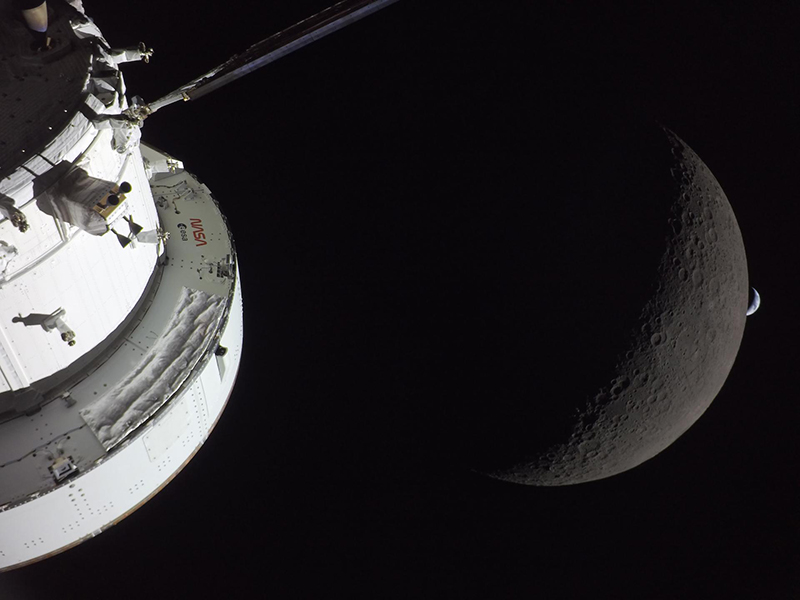
NASA’s Orion spacecraft captures the Moon and the Earth in one frame during the Artemis II crew’s deep space journey at 6:42 p.m. ET on the sixth day of the mission. [CREDIT: NASA]
The Artemis II mission was designed as a crewed validation of NASA’s deep space architecture. The crew ventured beyond low Earth orbit for a multi-day journey to the Moon’s orbit when they launched on April 1, performed a lunar flyby, and returned safely back to Earth about 10 days later. Unlike Artemis I, which was an uncrewed mission, Artemis II introduced human factors into every phase of the flight, from launch and translunar injection (the high-thrust maneuver used to propel spacecraft free from Earth’s orbit and onto a trajectory toward the moon), to navigation, communication, and reentry.
The mission profile followed a free-return trajectory, carrying the crew to lunar distances before looping them around the Moon and back toward Earth without the need for major propulsion corrections. This approach provided a controlled way to test deep space systems while maintaining a built-in safety margin. Throughout the mission, Orion’s life support systems, avionics, and thermal protection were put to the test under real conditions, offering data that cannot be replicated in ground testing or short-duration orbital flights. The crew also captured some stunning images throughout the mission with modern camera equipment that wasn’t available to the Apollo astronauts, showcasing Earth’s nearest companion up close.
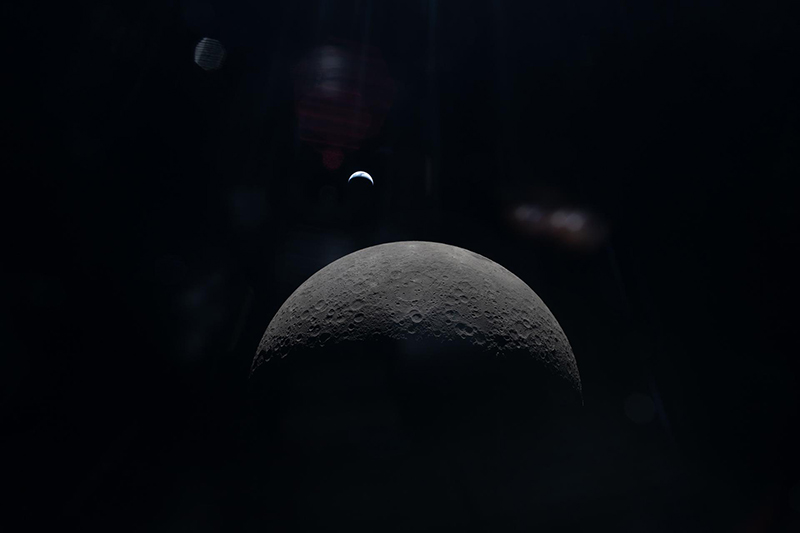
The Artemis II crew captures a faint view of a crescent Earth above the horizon on the Moon’s far side. [CREDIT: NASA]
By the time the crew returned and splashed down, Artemis II had made history and accomplished its main objective. NASA proved it can reliably send humans to lunar distances and bring them home, setting the foundation for the missions that follow. Artemis III is next.
What’s planned for Artemis III?
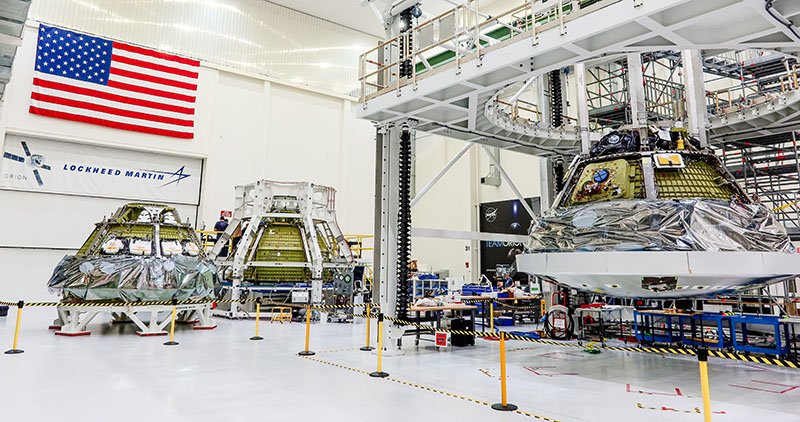 The Orion spacecraft for Artemis II (right), Artemis III (left), and Artemis IV (center) missions are stationed next to each other inside the high bay of the Neil Armstrong Operations and Checkout Building at NASA’s Kennedy Space Center on June 22, 2023. [CREDIT: NASA]
NASA now needs to demonstrate the Artemis mission infrastructure as a whole before committing to the perilous task of safely putting astronauts back on the lunar surface, and then getting them back off the surface. It’s been more than 50 years since we’ve done it, and it wasn’t any easier back then.
Up to three spacecraft are expected to take part when Artemis III is given the green light. The first is the astronauts aboard the Orion that launches on top of the SLS, who will lift off into Earth’s orbit. From there, the Orion crew capsule is to meet up with one or both Human Landing System (HLS) craft intended to bring astronauts to the lunar surface, under development by SpaceX and Blue Origin. Demonstrating the docking and crew transfer procedures is going to be a critical part of this mission and an essential step to check off before committing to Artemis IV.
Artemis IV and the First Steps Toward a Lunar Presence
[CREDIT: NASA]
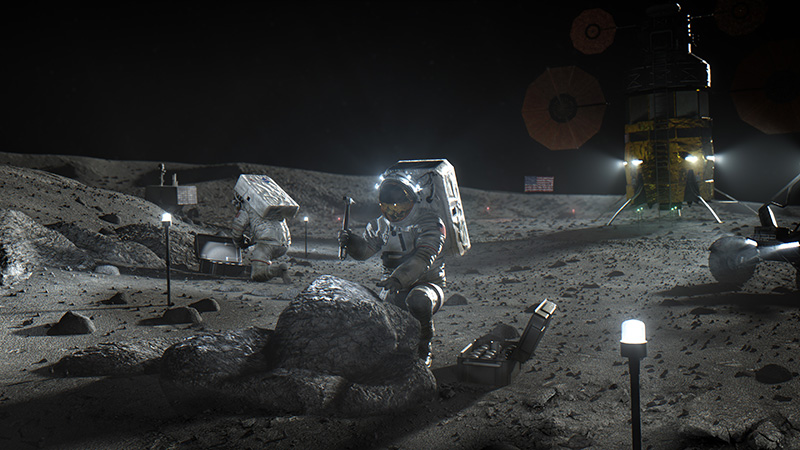
Artemis IV is expected to be the mission where the sequencing demonstrated during Artemis I, II, and III finally pays off. Currently targeted for early 2028, Artemis IV is planned to bring astronauts back to the lunar surface for the first time since Apollo 17.
Here’s how everything is expected to unfold. The Orion capsule will carry the crew beyond Earth, rendezvous with an HLS, and support the transfer of astronauts from deep space orbit to lunar descent. From there, the lander will carry crew members down to the Moon’s surface, where they will conduct scientific activities, test new equipment, and begin authenticating the technologies needed for longer and more ambitious stays.
It will be a triumphant moment when the first astronaut to visit the Moon’s surface since the Apollo program takes that first step. But that isn’t what this is entirely about. Artemis IV is not simply intended to be another flags-and-footprints mission, where humans briefly touch another world, plant a flag, and leave.
The broader goal of Artemis is to begin shifting lunar exploration from short-duration visits to a sustained human presence. NASA’s long-term plan is to use the Moon as both a proving ground and a staging point, testing the surface systems, habitats, spacesuits, mobility platforms, communications networks, power infrastructure, and resource utilization concepts needed to support human beings beyond Earth for more than a few days at a time.
Apollo proved that humans could reach the Moon. Artemis is meant to prove that humans can go back, stay longer, work more effectively, and start building the foundation for something permanent. In the years that follow, that could mean the development of a larger deep space economy, a sustained human foothold on another world, and eventually, crewed missions to Mars.
What Comes After Artemis IV?
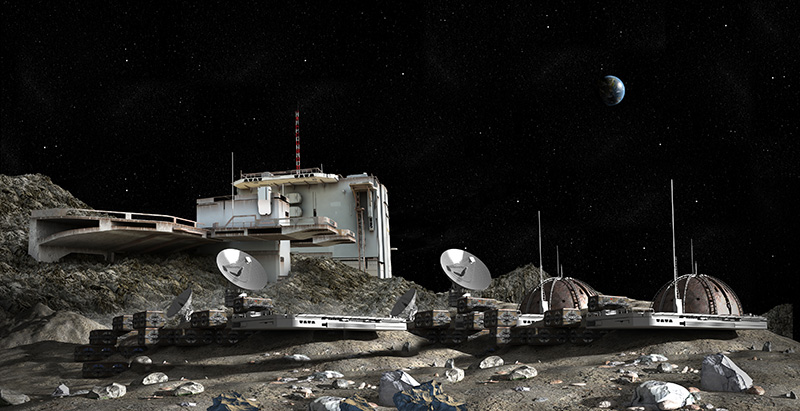
Stock image illustrating what a future lunar installation could look like.
Imagine it’s sometime in early 2028. The Artemis IV crew has safely splashed down somewhere in one of Earth’s oceans, and the world is reveling in humanity’s return to the lunar surface a few days earlier in an event that was televised to the world. What do we do now?
Now it’s time to establish a foothold.
After Artemis IV, the program is projected to become less about proving we can still reach the Moon and more about whether we can actually operate there. Getting astronauts back to the lunar surface will be historic, but the harder and more consequential challenge is everything that comes after: keeping equipment alive, landing cargo repeatedly, moving across hostile terrain, generating power through long periods of darkness, extracting useful resources, and eventually supporting astronauts for weeks or months at a time in one of the most unforgiving and harshest environments humans have ever tried to work in.
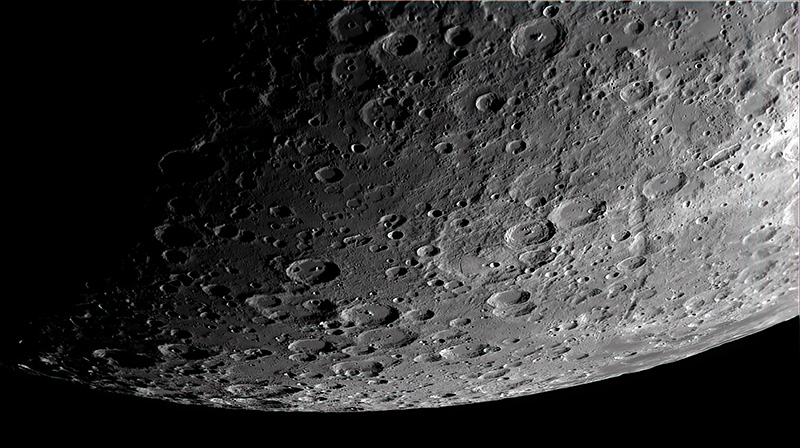
NASA has identified the Moon’s South Pole as the ideal region for a long-term lunar outpost. [STOCK IMAGE]
NASA’s long-term vision for a sustained lunar presence is centered on the Moon’s South Pole, a region far different from the equatorial plains visited during Apollo. The attraction is obvious. The South Pole contains permanently shadowed craters that may hold frozen resources, including water ice, which could eventually support life support systems, oxygen production, radiation shielding, and more. But the same features that make the region valuable also make it brutal. The Sun sits low on the horizon and casts long shadows across ridges and craters. Some areas may receive near-constant illumination, while others sit in extreme cold and darkness for long periods. A future lunar base will have to survive that environment not as a one-off stunt, but as a functioning outpost.
A future Moon base is likely going to resemble a networked system of structures instead of a simpler pressurized cylinder dropped onto a flat gray plain. Habitats, landing zones, power stations, communications relays, navigation assets, rovers, cargo depots, robotic systems, science payloads, and resource prospecting equipment will all need to work together across a landscape where line-of-sight can be blocked by terrain and where a simple maintenance job may require a spacesuit, a rover, and hours of careful planning. The goal is to gradually move from self-contained early missions toward common surface infrastructure that can support multiple crews, multiple landers, and eventually a long-term human presence.
Artemis is aiming to become the roots of a supply chain unlike its Apollo predecessor, which was more of an expedition and took place amidst the backdrop of the Cold War. Instead of a single spacecraft carrying everything astronauts need for a short stay, the post-Artemis IV era will likely depend on repeated cargo deliveries, pre-positioned surface systems, robotic assembly, power infrastructure, and vehicles capable of moving crew and equipment across the lunar South Pole. Moon installations will be built piece by piece through years of landers arriving with power units, spare parts, tools, communications hardware, mobility systems, scientific instruments, and eventually habitation modules.
One of the most important pieces of equipment during this venture will likely be the vehicles astronauts will use to get around. During Apollo, the electric Lunar Roving Vehicle (LRV), famously known as the “Moon Buggy,” expanded the astronauts’ reach, but those missions were still measured in days and relatively short traverses. Artemis is aiming for something closer to field geology on another world. NASA has been working with commercial teams on the Lunar Terrain Vehicle (LTV) to meet the scope of the Artemis mission. The LTV is an unpressurized rover slated for deployment beginning with Artemis V that suited astronauts could use around the South Pole. It's currently in the early stages of development. A pressurized rover would take that concept much further, essentially becoming a mobile habitat that allows astronauts to live and work away from base camp for extended periods.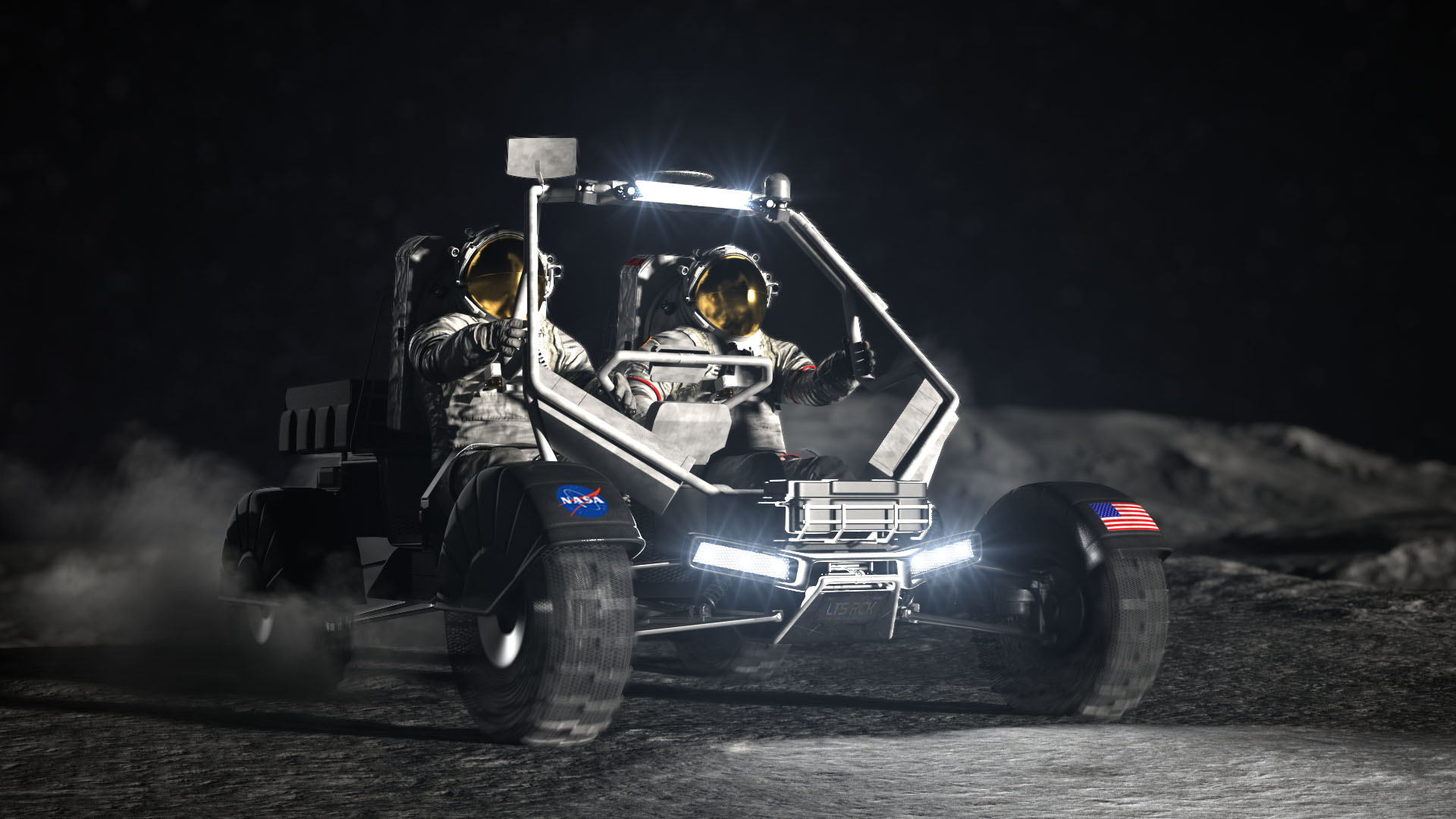
An artist's concept design of NASA's Lunar Terrain Vehicle. [CREDIT: NASA]
That rover could be the difference between visiting the Moon and actually exploring it. Instead of astronauts spending most of their time fighting the suit, managing consumables, and racing against extravehicular activity (EVA) timelines, a pressurized rover would let crews travel farther, work longer, and conduct their duties across a much wider area. It could function as a mobile laboratory, a shelter, a scouting platform, and a bridge between isolated points of interest across the South Pole. Between crewed missions, robotic rovers and remotely operated vehicles could continue the work: inspecting equipment, scouting landing zones, repositioning assets, collecting data, and preparing the surface for the next crew before they ever leave Earth. These systems have already been demonstrated throughout decades of robotic exploration on Mars. As of April 2026, NASA’s Perseverance and Curiosity rovers are still active and roaming around on the red planet.
Power is another make-or-break problem. A lunar base cannot depend on “plugging in” the way a terrestrial outpost can. Solar power will be useful in illuminated regions, but the South Pole’s lighting environment is complicated. The region features low Sun angles, long shadows, and periods of darkness that make storage and distribution just as important as generation. The future lunar base needs something closer to a microgrid than a battery pack. Habitats, rovers, scientific instruments, communications nodes, and resource utilization systems will all need reliable power in a place where an outage could be an existential event.
The presence of abrasive and electrostatic lunar regolith material on the Moon’s surface also poses a threat to the connections, contact points, and overall system integrity of all essential systems and infrastructure. Lunar regolith is a sharp, clingy dust that can be lofted and electrostatically adhere to suits, seals and equipment. It consists of jagged particles such as basalt and glass and tends to get into everything. The operational considerations posed by lunar regolith and all the aforementioned challenges discussed must be addressed and mitigated if a sustained lunar outpost is to flourish.
If the Artemis program and NASA’s overarching lunar goals prove successful over the next 10-20 years, the next stop could be Mars.
Interconnect Systems for Essential Connections in Space
Amphenol offers a variety of solutions intended to address the interconnected challenges of prolonged space travel.
Deep Space 38999 Connectors
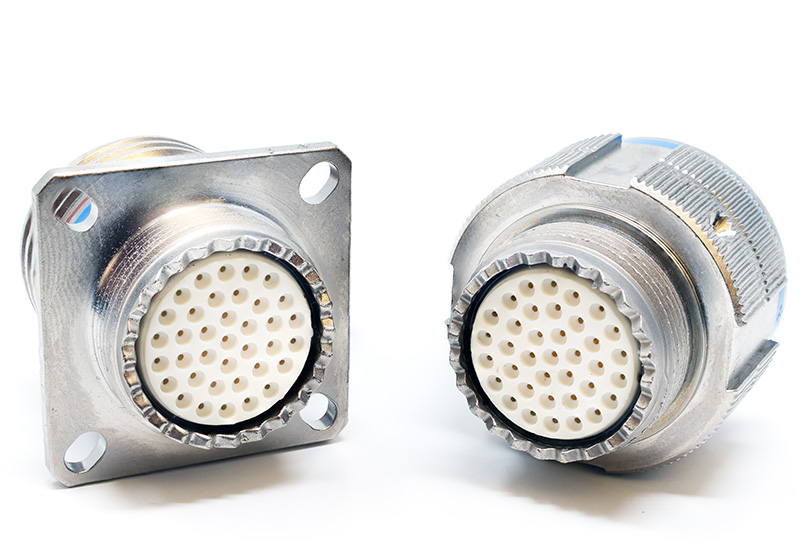
Connector survivability at cryogenic temperatures becomes a system-level requirement rather than a materials footnote the farther you journey from Earth. Amphenol’s Deep Space 38999 series is built specifically to retain grommet-to-wire sealing and contact-to-contact isolation in temperatures below -85° Fahrenheit (-65° Celsius), with upgraded elastomers and materials capable of operating at temperatures as low as -319° Fahrenheit (-195° Celsius).
That matters in deep space architectures because conventional elastomeric components can crack, lose sealing integrity, or create pathways for electrical shorting once thermal conditions fall far enough. Deep Space 38999 is designed to prevent these failures and preserve both environmental sealing and electrical integrity when standard connectors begin to reach their limits.
SpaceVPX Vita 78 Connectors
.jpg)
As spacecraft payloads continue to look more like ruggedized data centers, the backplane becomes one of the most important interconnect layers in the vehicle. Amphenol’s SpaceVPX VITA 78 Connectors are built to address these issues.
Leveraging OpenVPX architecture and configured to the VITA 78 specification, they are designed for space-based electronic systems that need to maintain high-speed data transfer, utility distribution, and fault-tolerant operation under radiation exposure, vibration, and temperature extremes. Their wafer loading scheme is specifically structured to achieve dual redundancy in support of fault tolerance requirements, which is not a minor feature in orbit. It is part of the underlying architecture that allows a system to keep functioning when there is no practical path to repair.
2M805 High Vibration Connectors

Launch is one of the most punishing phases any space system will ever see, and connector back-off under sustained vibration is one of the quieter ways a system can fail before it ever reaches orbit. Amphenol’s High Vibration 2M805 Connectors were developed to address that problem directly. Based on the microminiature 2M805 form factor but modified to meet MIL-DTL-38999 severe vibration requirements, the design enhances the plug shell and coupling nut geometry to increase coupling and uncoupling torque and mitigate the risk of loosening in high-vibration operation. That makes them especially useful in dense space assemblies where size and weight need to come down.