.jpg)
Robotic Combat Vehicle (Light), RCV(L), prototypes during Soldier Experimentation at the National Training Center, NTC, Fort Irwin, Calif. from July to September 2023. The RCV, part of the U.S. Army’s Next Generation Combat Vehicle (NGCV) initiative, is a remotely operated unmanned ground vehicle (UGV) with developing autonomous capabilities. Envisioned to provide a variety of roles while keeping soldiers out of harm’s way, these prototype offensive configurations pictured above are equipped with FGM-148 Javelin anti-tank missile systems, machine guns, and smoke launchers. [U.S. ARMY PHOTO]
By Stephen Borgna
Marketing Communications Specialist
Up until a few years ago, any mention of an unmanned system would bring to mind a small-scale, niche supporting platform. This included small- and-medium-sized unmanned aerial vehicles (UAVs) such as the MQ-9 Reaper and RQ-4 Global Hawk for conducting Intelligence, Surveillance, and Reconnaissance (ISR) missions or discrete precision strikes; explosive ordnance disposal (EOD) robots; and early-generation small loitering drones, for example.
The unmanned systems landscape is completely different now. These systems are growing exponentially in size, scale, and complexity as advancements in hardware and artificial intelligence push the limits of what was once possible. As a result, unmanned systems are transitioning from a specialized supporting asset into a dedicated layer of modern force projection. As their missions expand, the platforms themselves are becoming more autonomous, sensor-heavy, data-intensive, power-dense, interconnected, and physically diverse, while encompassing much larger and structurally complicated system architectures that increasingly resemble those of traditional crewed combat platforms.
Ukraine and the Rapid Expansion of Unmanned Systems
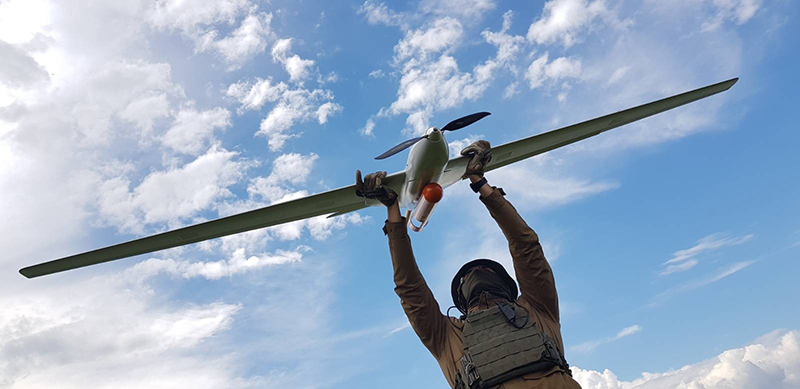
A Ukrainian soldier holds a Punisher Unmanned Combat Aerial Vehicle (UCAV) drone. [PUBLIC DOMAIN]
Unmanned systems had steadily grown more capable and advanced in the years leading up to Russia’s full-scale invasion of Ukraine in 2022, but their battlefield use was still largely confined to small- and-medium commercial and modified drones for niche uses such as ISR and precision strike.
The unmanned ecosystem gradually expanded in the months that followed the outbreak of hostilities as the front lines began to calcify across Eastern Ukraine. As maneuvering became increasingly bottlenecked by intricate defenses, artillery, mines, and persistent surveillance apparatuses, the operational environment began to resemble a brutal combination of First World War trench warfare and science fiction.
As both sides became deadlocked and built out long, elaborate trench networks and defensive positions, commercial quadcopters and basic first-person-view (FPV) drones were increasingly used to find targets and direct fire, attack vehicles and personnel, and create localized advantages along a front that had otherwise remained largely static. These tactics evolved over the years into a sprawling ecosystem of reconnaissance and strike UAVs, long-range one-way attack drones, increasingly autonomous systems, unmanned ground vehicles, maritime drones, and the digital command-and-control infrastructure needed to coordinate them at scale.
In June 2026, Ukraine’s Ministry of Defense stated unmanned systems are responsible for more than 90 percent of enemy targets struck by Ukrainian defense forces, with more than 800,000 verified drone strikes recorded since the beginning of the year. These statistics illustrate that unmanned systems have become one of the built-in primary layers of Ukraine’s combat capabilities. They’re not merely supporting actors in the conflict anymore.
Ukraine’s Drone Line initiative, for instance, is attempting to deploy unmanned systems on a systematic scale by establishing a 10-15-kilometer-deep denial zone ahead of Ukrainian positions, where enemy forces cannot enter without sustaining losses. The initiative combines continuous aerial support for infantry with persistent drone engagement across that depth. According to Ukraine’s Ministry of Defense, Drone Line units within the country’s Unmanned Systems Forces neutralized more than 30,000 enemy personnel during the winter of 2025-2026 alone.
These developments are being watched closely around the globe as the world’s advanced militaries attempt to transcribe the lessons of Ukraine into how they prepare for future threats.
From Supporting Platforms to Mission-Critical Systems
.jpg)
A Textron Systems TSUNAMI unmanned surface vehicle (USV) sails during the U.S. Navy’s annual Fleet Experimentation (FLEX) event in Key West, Fla., April 24, 2026. [U.S. NAVY PHOTO]
Ukraine is possibly the clearest real-world example of how rapidly unmanned systems have scaled in recent years. But the broader trend extends far beyond the relatively inexpensive drones that have become ubiquitous over the battlefield. Across air, land, and maritime domains, militaries are developing unmanned platforms that are larger, more autonomous, more heavily armed, and capable of performing missions once reserved almost exclusively for crewed systems.
This growth is occurring across both small and large systems. Small drones are being deployed in enormous numbers and increasingly coordinated through sophisticated command-and-control networks, while much larger unmanned aircraft, ground vehicles, and maritime platforms are being designed around advanced sensors, high-performance computing, electronic warfare systems, weapons, and autonomous mission software. The unmanned ecosystem is scaling rapidly in both quantity and complexity of the individual systems themselves.
The Unmanned Platform Is Getting More Complex
.jpg)
Demonstrator (MET-D, rear) and two Robotic Combat Vehicles (RCVs) maneuver through a Fort Carson, Colorado training area in early July 2020 at the control of Soldiers from 4th Squadron, 10th Cavalry Regiment, 3rd Armored Brigade Combat Team, 4th Infantry Division. The MET-Ds and RCVs the Soldiers used were surrogate platforms built using existing Army vehicles for the sake of expedience and cost-saving, but as development continues, vehicle platforms will change. [U.S. ARMY PHOTO]
Just because the crew is removed doesn’t mean a vehicle becomes simpler.
In many cases, it does the opposite, as all the functions typically performed by a human crew must be relegated to the system’s onboard architecture or arranged so that a human crew can perform these functions remotely. In a complex unmanned system, functions previously performed by a human crew now have to be supported by combinations of advanced subsystems such as electro-optical and infrared sensors; radar and lidar; navigation systems; mission computers; artificial intelligence processors; electronic warfare equipment; weapons-control electronics; sophisticated power and data networks, and more.
All the new families of medium-to-large unmanned systems beginning to come online demonstrate this level of complexity and intricate onboard system architecture as the battlefield becomes more and more unmanned.
Unmanned Ground Vehicles (UGVs)
.jpg)
A U.S. Army Small Multipurpose Equipment Transport (SMET) maneuvers in an urban training environment as part of a human machine integration experiment at Fort Irwin, Calif., March 11, 2024. The SMET is an eight-wheeled, enabling robotic technology serving as a “robotic mule” with a wide range of flexibility to operate in combat, combat support and combat service support operations. [U.S. ARMY PHOTO]
Unmanned ground vehicles were once largely limited to specialized support missions such as explosive ordnance disposal, route clearance, and carrying equipment.
Newer platforms are moving closer to the point of contact, taking on reconnaissance, screening, logistics, sensing, and potentially direct combat roles alongside soldiers on the ground. Ukraine, for example, has initialized fielding 25,000 UGVs through the first half of 2026 to replace soldiers in front-line logistics operations.
The U.S. Army’s Robotic Combat Vehicle is a major program that’s intended to operate alongside ground personnel or take on riskier roles that often went to human operators. RCV prototypes have been undergoing testing and demonstrations for several years now with the goal of tasking operated and semi-autonomous vehicles to scout ahead of soldiers, carry advanced sensors and communications equipment, and support weapons employment while reducing crew exposure.
.jpg)
A Robotic Combat Vehicle (Light), RCV(L), prototype during Soldier Experimentation at the National Training Center, NTC, Fort Irwin, CA from July to September 2023. [U.S. ARMY PHOTO]
That added mission responsibility brings additional electronic complexity. A modern UGV may combine navigation sensors, electro-optical systems, tactical radios, onboard computing, remote weapon interfaces, power management, and autonomous mobility functions within a single ruggedized platform. The same pattern is emerging across the air and maritime domains as unmanned vehicles are asked to do more than simply observe or carry equipment.
The same trend is taking place at the opposite end of the spectrum. The Army’s Small Multipurpose Equipment Transport (S-MET) is intended primarily to reduce the physical burden on soldiers by carrying equipment and supporting mobility. Even comparatively utilitarian unmanned vehicles like S-MET increasingly incorporate robotic control, power systems, communications, and autonomous mobility functions.
USVs and UUVs
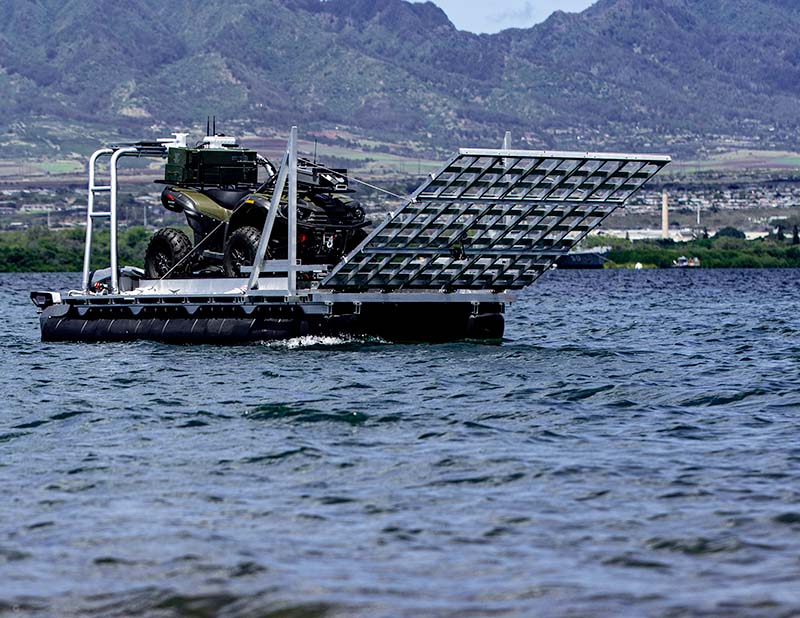
An unmanned surface vessel (USV) maneuvers through Pearl Harbor, Hawaii, during a rehearsal for Project Convergence - Capstone 5 (PC-C5) in April 2025. [U.S. ARMY PHOTO]
Similar expansions in unmanned capability are taking place at sea, with unmanned surface vessels (USVs) and unmanned underwater vehicles (UUVs) increasingly being developed for missions such as surveillance, reconnaissance, mine warfare, electronic sensing, strike, and other operations once reserved for crewed ships and submarines. Ukraine has provided one of the clearest demonstrations of what relatively small USVs can accomplish in combat. The country’s deployed maritime drones repeatedly against Russian naval assets in the Black Sea that’ve helped it impose significant costs on a much larger conventional fleet. Ukraine’s Ministry of Defence has credited unmanned maritime systems as an important part of the campaign that has damaged or destroyed a substantial share of Russia’s Black Sea Fleet.
At the other end of the scale, the U.S. Navy is pursuing much larger unmanned platforms intended to operate for extended periods with little or no onboard human intervention. The Navy’s Orca Extra Large Unmanned Undersea Vehicle, for example, is an approximately 85-foot autonomous diesel-electric submarine with a modular payload section, while DARPA’s Manta Ray program has explored large UUV technologies intended for long-range, long-duration missions without requiring nearby crewed vessels or regular human maintenance. These programs illustrate how unmanned maritime systems are beginning to move beyond remotely operated drones and toward autonomous ships and submarines with increasingly sophisticated propulsion, navigation, communications, sensing, and mission systems.
That level of autonomy creates a significant reliability problem. A crewed vessel has sailors available to inspect machinery, troubleshoot electronics, and respond when equipment begins to degrade; an unmanned vessel expected to remain at sea for days or weeks must rely much more heavily on automation, redundancy, health monitoring, and durable onboard systems. The maritime environment compounds those demands through saltwater, corrosion, vibration, pressure, limited underwater communications, and the need to move large quantities of sensor data. The Navy has even conducted repeated 720-hour “no-touch” engine and generator demonstrations to prove that propulsion and electrical systems intended for future USVs can operate continuously without human intervention.
Drones and Swarms
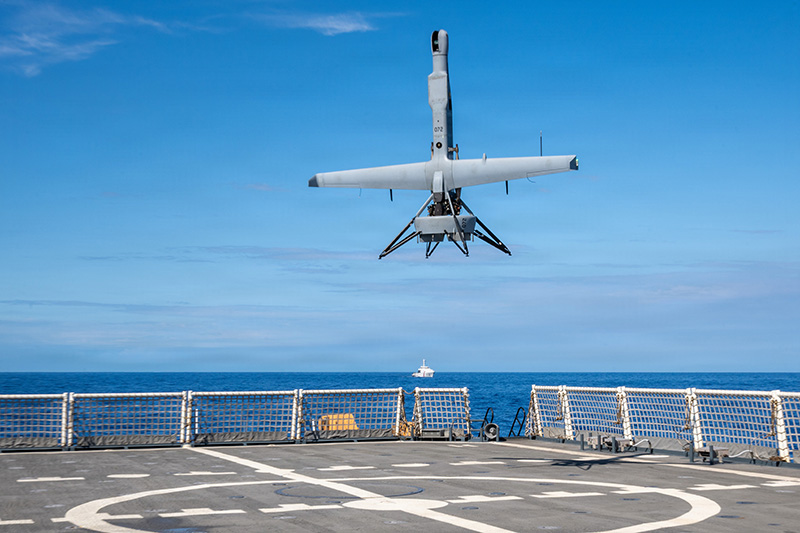
A V-BAT reconnaissance unmanned aerial vehicle lands on the flight deck of Legend-class cutter USCGC Kimball (WMSL 756) during RIMPAC 2026 in the Pacific Ocean, July 15, 2026. [U.S. COAST GUARD PHOTO]
Small drones have exploded in usage and operational relevance throughout the 2020s. Individual first-person-view (FPV) drones, quadcopters, and other small UAS can remain relatively simple compared with a large UGV, USV, or combat aircraft. But as militaries have begun operating them in greater numbers and coordinating their movements, sensing, and effects, much of the complexity shifts away from the individual airframe and into the network connecting the platforms together.
A true drone swarm is more than a large number of aircraft launched at the same time. Swarming concepts increasingly rely on varying degrees of collaborative autonomy, allowing individual systems to share information, divide tasks, maneuver around one another, and respond to changing conditions with less direct input from a human operator. DARPA’s OFFensive Swarm-Enabled Tactics (OFFSET) program explored this concept years before the current explosion in battlefield drone use, envisioning swarms of up to 250 collaborative autonomous air and ground systems operating in dense urban environments. During its final field experiment, supporting technologies included automated systems capable of launching, recovering, and charging as many as 80 drones, along with onboard collision-avoidance technologies intended to allow aircraft to maneuver through complicated terrain.
The concept has since become increasingly relevant as militaries look for ways to field unmanned systems at much greater scale. The Pentagon’s Replicator initiative, launched in 2023, was explicitly structured around fielding thousands of attritable autonomous systems across multiple domains. This reflects a vision in which large numbers of comparatively inexpensive unmanned platforms supplement smaller inventories of crewed systems.
Scaling from one drone to dozens or hundreds creates an entirely different systems problem. Operators cannot realistically fly every aircraft individually, forcing more navigation, coordination, target allocation, and sensor management onto onboard processors and autonomous software. Communications networks must simultaneously move information between vehicles, operators, sensors, and command systems, often while operating under electronic attack or degraded connectivity. The individual drone may remain relatively inexpensive, but the infrastructure required to turn large numbers of them into a coordinated combat capability becomes considerably more sophisticated.
Ukraine is already demonstrating this under harrowing combat conditions. In 2026, Ukraine’s Ministry of Defence reported that artificial intelligence was increasingly allowing drones to remain effective despite electronic warfare and even complete portions of missions after losing their connection to an operator. Ukrainian developers have also fielded interceptor drones in which autonomous systems can perform most of the interception missions against Shahed-type one-way attack drones that have been deployed by Russia en-masse.
That evolution also creates a corresponding problem for the defender. The same combination of scale, autonomy, and distributed coordination that makes large numbers of drones increasingly effective makes them much harder to detect, track, and defeat with conventional air-defenses. As offensive drone systems become more numerous and automated, counter-UAS systems are being forced to evolve alongside them.
Counter-UAS
.jpg)
U.S. Marines with 12th Littoral Anti-Air Battalion, 12th Marine Littoral Regiment, 3rd Marine Division, fire a XM914 30mm chain gun mounted on a Marine Air-Defense Integrated System during a live-fire range at Camp Schwab, Okinawa, Japan, July 28, 2026. The MADIS is the U.S. Marine Corps’ advanced mobile air defense system designed to detect, track, and neutralize drones and low-altitude aircraft using missiles, cannons, and electronic warfare. [U.S. MARINE CORPS PHOTO]
The rapid proliferation of small drones has forced counter-unmanned aircraft systems (C-UAS) to become considerably more utilized, and sophisticated, in response. Earlier counter-drone solutions could rely heavily on electronic warfare, small arms, or existing air-defense systems, but today's threat includes FPV drones, one-way attack systems, autonomous platforms, and large numbers of aircraft approaching simultaneously. Modern C-UAS architectures increasingly combine radar, radio-frequency detection, electro-optical and infrared sensors, electronic warfare, and automated command-and-control systems to detect, classify, track, and prioritize threats before selecting an appropriate method of defeat.
The Department of Defense has increasingly treated the problem as a distinct, cross-domain mission, including through its 2024 Strategy for Countering Unmanned Systems. The counter-UAS mission became even more apparent during recent operations in Iran as part of Operation Epic Fury.
The variety of defeat mechanisms has expanded just as quickly. During U.S. Army counter-UAS demonstrations in recent years, systems have employed everything from machine guns and rockets to electronic warfare, interceptor drones, high-powered microwaves, and other directed-energy technologies. The Army has also continued testing laser-based air defenses such as DE M-SHORAD as they’ve sought lower-cost methods of defeating large numbers of inexpensive aerial threats without relying exclusively on comparatively expensive surface-to-air missiles.
The modern counter-UAS platform can resemble a compact integrated air-defense network more than a single weapon alone. Multiple sensors must feed large amounts of data into processing systems capable of distinguishing drones from other objects, tracking several targets simultaneously, and cueing the most appropriate electronic or kinetic effector. This often needs to happen within seconds. As offensive unmanned systems continue to scale in number, autonomy, and sophistication, the systems built to stop them are consequently becoming more sensor-intensive, computationally demanding, and electronically complex as well.
AI/GCS Infrastructure
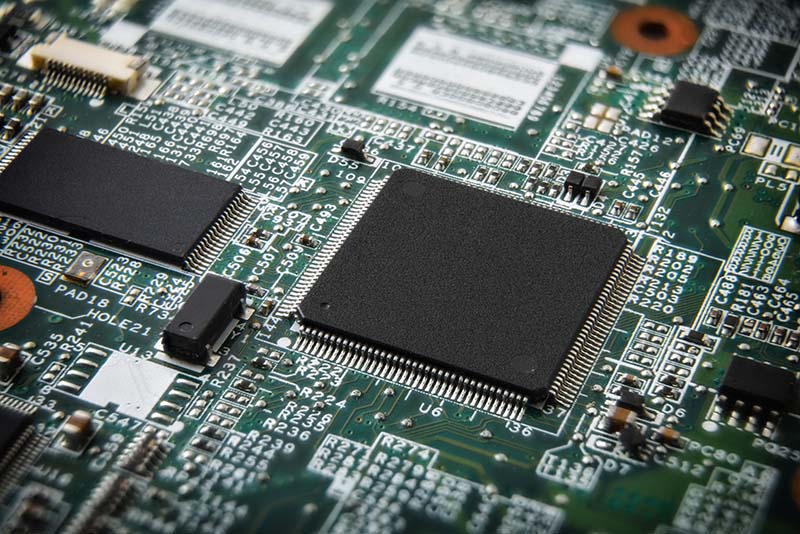
A closeup of a printed circuit board [STOCK IMAGE]
The infrastructure used to control and coordinate this new generation of unmanned systems is becoming more sophisticated as these systems become more independent. Earlier unmanned aircraft often depended on dedicated crews directly operating a single vehicle through a ground control station. That model becomes increasingly difficult to sustain as militaries field larger numbers of autonomous platforms across multiple domains. Programs such as DARPA’s Collaborative Operations in Denied Environment (CODE) have explored architectures in which one mission supervisor can oversee multiple unmanned aircraft that share information, evaluate their environment, and recommend coordinated actions rather than requiring continuous manual control of each vehicle.
Artificial intelligence is pushing more of that decision-making toward the edge. Instead of sending every sensor feed back to a distant operator for interpretation, unmanned systems can increasingly process data onboard, identify objects of interest, navigate around hazards, and coordinate with other platforms before passing the most relevant information up the chain. The U.S. Air Force demonstrated this in 2025 when F-16 and F-15E pilots each controlled two XQ-58A Valkyrie autonomous unmanned stealth aircraft during an air-combat training scenario.
As a result of this ground control stations are evolving from a remote cockpit into part of a much larger command-and-control and computing architecture. Tactical servers, high-speed networks, radios, datalinks, AI processors, mission computers, and human-machine interfaces must connect individual unmanned vehicles with operators and other battlefield systems while maintaining performance in contested electromagnetic environments.
Collaborative Combat Aircraft (CCAs)
.jpg)
A YFQ-44A Collaborative Combat Aircraft fires an AIM-120 weapon in secluded airspace over the Mojave Desert. The live-fire test of the YFQ-44 aircraft is the latest milestone in the rapid development of safe and effective CCA operations. [U.S. AIR FORCE PHOTO]
Collaborative Combat Aircraft (CCAs) are perhaps the clearest example of how far unmanned systems have scaled in size, capability, and mission responsibility in recent years. Rather than serving primarily as reconnaissance platforms or remotely piloted strike aircraft, CCAs are being developed as uncrewed combat aircraft capable of operating alongside crewed fighters, extending sensing and weapons reach, and adding additional mass to fighter formations. They are envisioned as a key feature to operate alongside the sixth-generation Boeing F-47 NGAD fighter program. The U.S. Air Force formally designated General Atomics’ YFQ-42A and Anduril’s YFQ-44A in 2025 as its CCAs of choice, and those programs have since been cleared for their initial production runs.
The internal architecture of CCAs is beginning to resemble those of sophisticated combat aircraft. Like their manned fighter counterparts, these systems also incorporate advanced flight controls, mission computing, sensors, communications, autonomy software, weapons integration, and high-speed data networks within a platform designed to operate without an onboard pilot.
More responsibility has shifted onto advanced sensors, processors, communications equipment, autonomy software, and the supporting ground infrastructure needed to coordinate its operation in place of a human pilot. As these platforms move closer to the complexity and combat relevance of conventional fighters, the interconnect layer must support their advanced requirements for reliable power distribution, high-speed data, and ruggedized electronics.
Interconnect Systems for the Next Generation of Unmanned Systems
Amphenol fully grasps the weight of the moment we’re witnessing with the growth and scaling of emerging unmanned systems. For these systems to achieve the levels of capability, autonomy, and mission reliability that’s demanded of them, they require an advanced and dense interconnect layer that can move more power and data through increasingly compact, ruggedized system architectures without compromising reliability. Amphenol interconnect technologies are ready now to meet these needs.
MIL-DTL-38999 Connectors with PCB Contacts
%20expanded.jpg)
As unmanned systems become more sensor-heavy and computationally dense, designers need rugged interconnect solutions that can tie external vehicle interfaces directly into increasingly compact onboard electronics. Amphenol’s MIL-DTL-38999 connectors with PCB contacts provide a direct board-level connection while retaining the durability and environmental performance associated with the 38999 family.
D38999 PCB connectors are available across a wide range of insert arrangements and contact sizes, with multiple receptacle styles, PCB tail lengths, plating options, and alignment accessories to support different packaging requirements.
Series Five Connectors
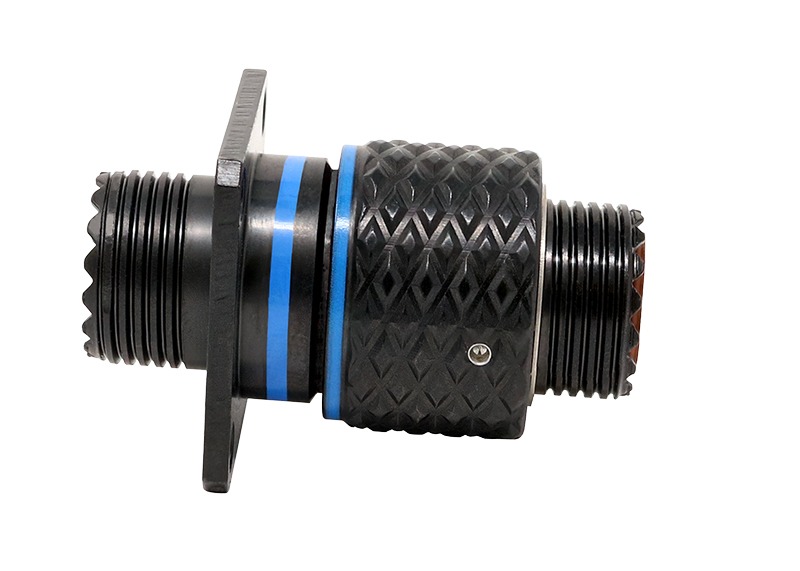
As unmanned platforms become more capable, designers are being asked to package greater amounts of sensing, computing, communications, and power hardware into vehicles where every inch of space and every ounce of weight can matter. Amphenol’s Series Five connectors were developed as the next evolutionary step in the MIL-DTL-38999 lineage, retaining the ruggedized performance characteristics of traditional 38999-style connectors in a smaller and lighter form factor.
Depending on configuration, Series Five connectors can provide weight savings of approximately 25 to 50 percent compared with MIL-DTL-38999 Series III, while also reducing overall connector size and supporting higher-voltage applications. The family also incorporates features such as scoop-proof construction, quick-coupling dual-start threads, EMI grounding, 38999-qualified insulators, and PCB-termination options.
MIL-HD2 Connectors
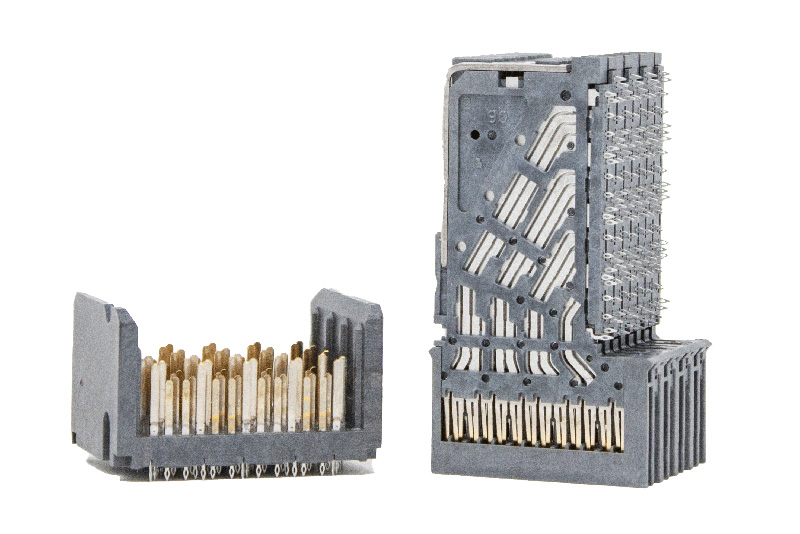
As unmanned systems become increasingly dependent on onboard AI, sensor fusion, autonomous mission processing, and high-speed networking, the embedded computing architecture behind those functions must move more data through increasingly constrained spaces. Amphenol’s MIL-HD2 is a next-generation VITA 91 and SOSA-aligned connector series designed for high-density military embedded computing applications, supporting data rates scalable to 56 Gb/s PAM4 while providing greater differential-pair density for tighter card pitches and chassis designs. Available in 3-, 4-, and 6-pair configurations, MIL-HD2 is intended for next-generation switch and payload cards where space, density, and signal integrity are increasingly critical.
R-VPX Connectors
%20clipped.png)
The growing amount of onboard processing in unmanned systems is driving greater demand for rugged, high-speed board-to-board connectivity inside mission computers, sensor processors, communications equipment, and other embedded electronics. Amphenol’s R-VPX connector family is designed specifically for VPX/OpenVPX architecture, providing a ruggedized VITA 46-compliant interconnect platform for moving high-speed data between cards and backplanes in demanding military environments.
The standard R-VPX connector system supports 3U and 6U VPX configurations, offers up to 140 signals per inch, and can be combined with VITA 66 optical, VITA 67 RF, and high-power modules within the same broader architecture. R-VPX EVO 2.0 connectors extend the family into even higher data rate speeds, supporting the increasingly bandwidth-intensive computing architecture required for AI processing, sensor fusion, electronic warfare, autonomous navigation, and command-and-control.
Rugged Ethernet Switches
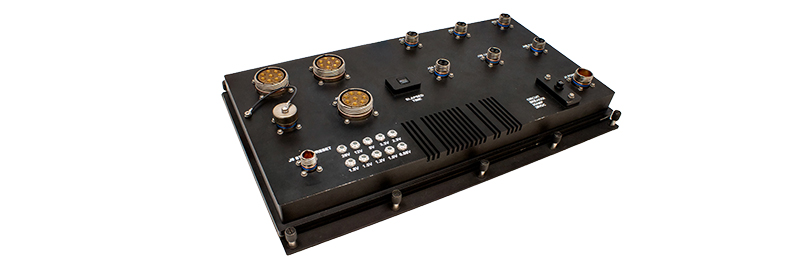
As unmanned systems become more interconnected, the ability to move large volumes of sensor, mission, and control data between onboard subsystems become increasingly important. Amphenol’s rugged VPX Ethernet switches are designed to provide that networking backbone inside high-performance military computing architectures, supporting configurable system connectivity across processors, I/O boards, media converters, and other high-speed components.
Amphenol High Speed Ethernet Switches include 3U and 6U VPX managed Ethernet switches with configurations ranging from 48-channel 10G systems to higher-density 25G platforms, including a 56-channel 3U switch and a 144-channel 6U switch whose ports can support 100G, 25G, 10G, 1G, or 100M Ethernet depending on system requirements.